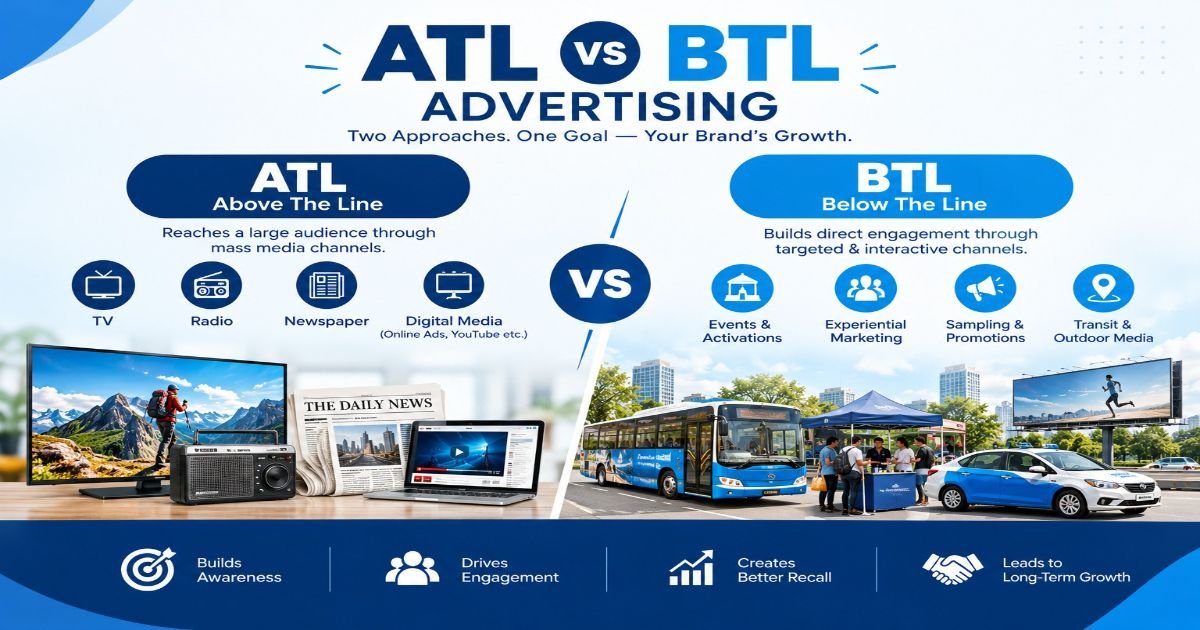
ATL vs BTL Advertising: The Difference Is Not Just Reach. It Is the Nature of Influence.
For years, the equation of ATL versus BTL has been said to be that BTL is about engagement and conversion, while ATL is about awareness. It's a handy explanation. It's also a half-told story.
TV commercials can make a difference in a sale. The right outdoor marketing can transform the perception of a brand. A sampling activity can generate thousands of interactions without creating a lasting preference. But a well-planned activation can draw large crowds to an event, even if it does not create a valuable business result.
The difference, however, isn't just a matter of the number of people a brand can reach or whether the consumer engages with the brand.
It's about the brand's intent to create an influence, the context in which it grows, and evidence to see if it did.
This distinction helps clarify that ATL and BTL are not merely a media classification exercise but a strategic discussion.
1. Reach Creates Familiarity. Context Creates Relevance.
The power of scale is the big advantage of ATL advertising. It is great for building brand awareness and getting a message across to a wide range of people.
Brands become more identifiable when they repeat in the media, whether it's television, radio, print, or outdoor. As consumers become familiar with a brand, that familiarity can shape how likely they are to recall it, how credible they perceive it to be, and whether they consider it in a purchase decision.
BTL operates through a different advantage: context.
A brand that is seen at a retail store, residential society, college campus, or workplace can be displayed in an appropriate context to its target market. An abstract proposition can become real during a product demonstration, sampling exercise, or live interaction.
There's a difference, but it's a significant one.
ATL can bring a brand to life before the buyer has an opportunity to buy. BTL can bring the brand to life at a time when the consumer has a more pressing need to interact.
Both of these are possible in both channels. The difference is in how the influence is produced.
2. Exposure and Experience Create Different Kinds of Impact
Not all advertising effects have to lead to an instant action!
In other instances, it's recognition that is the desired result. But sometimes it's a shift in perception. Other times, it's curiosity, testing, weighing, or a physical purchase.
ATL is especially applicable for creating mental availability—the probability that a brand will "pop into someone's head" when a need arises. It can have a cumulative effect even if the consumer is not reacting to the exposure immediately.
BTL can inspire consumers to do more than just be aware; it can make them do something. The consumer can taste a product, speak to a representative, have a demo, or get information according to a specific need.
But interaction does not necessarily equal impact.
The person who takes the sample doesn't necessarily become a customer. Consumers visiting a kiosk with a brand name do not necessarily exhibit brand preference. Similarly, somebody who sees a commercial without taking action (clicking, calling, or shopping in a store) can still recall the brand weeks later.
The question is, did the consumer see or come in contact with the campaign or not? What changed was this.
It could be awareness, recall, understanding, confidence, trial or purchase behavior that changes. The right measure is dependent on the goal.
3. The Measurement Difference: Estimated Exposure Versus Observable Response
The one distinction between ATL and BTL that is the most helpful is not that one is measurable and the other is not. Both can be measured, but the kind of evidence that must be collected is different.
Reach, Frequency, Impressions, Gross Rating Points, Share of Voice and Brand-lift studies are typical measures used in ATL campaigns. These can be useful in helping marketers to gauge the scope of reach and—if the right research is undertaken—whether it affected awareness, consideration or brand perception.
Immediate operational evidence can be created from BTL campaigns: number of people approached, meaningful interactions, samples given out, demonstrations, qualified leads captured, coupon redemptions and sales can be linked to an activation.
These measures are useful but are not equal.
Think about the difference between sending out 5,000 samples and turning 500 interested customers into product trials. Both are activity figures, but the latter is a more meaningful measure of consumer response.
Likewise, an outdoor campaign that is large can be very visible, but it can't, as a whole, provide a direct measure of what individuals were exposed to. Effectiveness should be evaluated using brand tracking, geographic comparisons, sales trends, or other complementary approaches.
A more useful measurement framework distinguishes between three levels:
- Delivery: Did the campaign reach its intended audience or execute as planned?
- Response: Did the audience notice, engage with, remember or act on the campaign?
- Outcome: Did the activity contribute to the business objective it was designed to support?
This distinction matters because activity reports can look impressive even when the underlying marketing objective remains unmet.
4. Attribution Is Not the Same as Effectiveness
BTL is often easier to measure, as we can document interactions at the time of execution. However, documenting an outcome does not demonstrate causation of the outcome by the campaign.
Having tried a product in the store may be the final factor that prompted a customer to buy it, or it may have been a previous commercial, a preference, a discount, or a suggestion from another customer.
Similarly, an increase in sales in the period of an ATL campaign does not automatically prove that the campaign contributed to the sales increase. Other factors, such as distribution, pricing, seasonality, and competition, can also play a role.
This is where measurement must go beyond numbers.
Unique campaign codes, QR codes, lead capture, geographic comparisons, exposed vs. control studies and sales analysis can be used to build better connections between campaign activity and resulting behavior.
This will depend on the campaign, data available, and the cost of measuring.
The challenge for ATL is often linking the overall exposure to how people change behavior in response to it.
With BTL, it's frequently differentiating between a recorded interaction and a real incremental outcome.
Both need more than several impressions or interactions.
5. ATL Builds Continuity. BTL Can Create a Moment of Decision
ATL / BTL can be integrated at various stages of the consumer's brand journey.
ATL can build a uniform brand image across markets, promoting the same proposition over time. Often the value is in the sum of the exposures, not in any one exposure.
BTL can help to make it a more concentrated encounter. It can help brands highlight product benefits, counter arguments, spur trial, or provide a clear next step.
Suppose a packaged food company enters a new city.
Outdoor advertising and radio can build brand recognition throughout the target market. Selected retail outlets can then enable consumers to try the product for themselves. The brand can then evaluate whether the campaign is driving the desired results at the retail level: trial and repeat purchase, based on consumer feedback.
Two channels are not the only reason that this combination is valuable. It's because each plays a different role in the consumer journey.
The wide campaign provides the consumer with brand recognition. The on-ground encounter will allow the consumer to experience it.
We can also turn a relationship around; feedback from an activation can indicate which benefits, messages, or objections should be strengthened in subsequent mass communication.
6. Scale Versus Precision Is a Planning Choice, Not a Contest
One thing people often equate with ATL is big audiences, and with BTL is targeted audiences. While this is helpful, it can be misleading when viewed as a measure of superiority.
It's good to have a wide reach if the opportunity is wide. For a consumer brand, it may not be necessary to invest in a big population if it is to be seen in several markets, but in a smaller, more targeted group.
On the other hand, a specialized product can be better served by attracting the right audience to the right context than by garnering a mass audience of non-relevant users.
Cost is the same:
Cost per thousand impressions isn't the same as cost per qualified interaction or cost per lead or cost per acquisition. The lower the cost per impression, the more efficient the campaign isn't, and vice versa for cost per interaction; 'the more efficient' is not necessarily the higher commercial return.
To compare anything is to have a common goal.
For raising awareness, compare incremental awareness cost and quality. If it is to bring product trials, then look at the cost of real trials to real conversion. If it is to drive sales, measure the incremental impact on sales, where it is possible to do so reliably.
The best media mix is not always the best in terms of the number of or cost of the individual media units. It is the one that helps to achieve the desired result at an acceptable cost.
7. The Boundary Between ATL and BTL Is Becoming Less Rigid
While useful, traditional media classifications will not be sufficient to accurately define campaign responsibilities or budget. The separation is not as clear when formats are used for mass visibility and direct interaction, though.
Think of a branded mobile van.
It plays a similar role to outdoor advertising when it is used in a high-traffic area and is delivering a prominent message from the brand.
Once the same van is parked at a residential society, it serves a different purpose and starts offering product demonstrations, giveaways, and even qualifying leads.
There has been no change in the physical asset. The campaign objective, execution, and measurement have changed.
This is a good example of how one should not judge a format or medium based on just its name. This can vary according to the brand's desired outcome.
Digital campaigns, sponsored experiences, and retail media are no exception to this rule, as mass distribution, precision targeting, and direct response can all work together.
It is important to note that marketers shouldn't try to fit every activity into a particular category; they should determine which is the main purpose of the investment and then choose the right measure to track.
8. The Strongest Strategy Begins with the Objective, Not the Channel
The ongoing discussion between ATL and BTL usually begins with a question about the budget—it should allocate how much for mass media and how much for on-ground activity?
Instead, it is better to begin by defining the problem that the brand needs to address.
Is the brand not known to the market? Does the brand have a reputation but not a well-differentiated reputation? Do shoppers know about the product but not want to sample it? Does the challenge apply to specific markets, stores, or audience segments? Or is the brand creating a level of trial with not enough repeat purchases?
These are other problems, and different interventions are required.
The benefit of ATL may be more applicable if it is important to build awareness, position, or build a consistent footprint in a large market.
BTL can be especially beneficial when it is important to illustrate a proposition, encourage trial, involve a specific target audience, and gain insight into local consumer reaction.
If both are needed, then each should be complementary and not repetitive. The message, experience, and outcome should be closely linked, and the campaign should have a clear relationship between them.
This is also where agencies can be more strategic—from merely suggesting media formats to describing the reasons behind a specific investment, the impact it is supposed to have, and how that impact will be measured.
Conclusion: Different Mechanisms, One Commercial Objective
We can see ATL and BTL as two separate aspects of advertising. In reality, they are variations of the same means of exerting influence.
They can achieve familiarity with a market. The latter can help bring a proposition closer to the consumer via a relevant encounter. One can provide proof of exposure and changes in brand perceptions; the other can provide more direct evidence of interactions and responses.
Both are not always more effective, and neither is a business performance predictor.
They are effective based on the goal, the audience, the quality of the execution, the external marketing climate, and the ability to measure the results appropriately.
The more significant difference is that you don't measure the success of advertising by activity; you measure it by a meaningful change in the relationship between a brand and its audiences.
After that, the importance of ATL and BTL is no longer in competition but in place.